
Malaysia will introduce revised Employment Pass (EP) salary requirements effective 1 June 2026, following updates approved by the Ministry of Home Affairs (MOHA). The changes will apply to both new Employment Pass applications and renewals submitted on or after the implementation date.
For employers hiring foreign professionals in Malaysia, the revised framework may have significant implications for workforce planning, compensation structures, and long-term talent strategies.
Higher Salary Thresholds Across All EP Categories
Under the revised policy, minimum salary requirements will increase across all Employment Pass categories.
The minimum salary for Employment Pass Category I will increase from RM10,000 to RM20,000 per month. Category II will require salaries between RM10,000 and RM19,999, while Category III will apply to salaries ranging from RM5,000 to RM9,999.
The revised thresholds represent a substantial increase compared to the current framework and may affect both future hiring decisions and renewal planning for existing expatriate employees.
What This Means for Employers
For many organizations, the most immediate impact will be on workforce budgeting and hiring strategies.
Employers may need to review current expatriate positions, assess compensation packages, and evaluate whether existing Employment Pass holders will continue to meet the revised requirements when renewal applications become due.
The changes may also influence future recruitment plans, particularly for companies relying on foreign talent for specialized or leadership roles.
Overview of Malaysia's Employment Pass Updates 2026
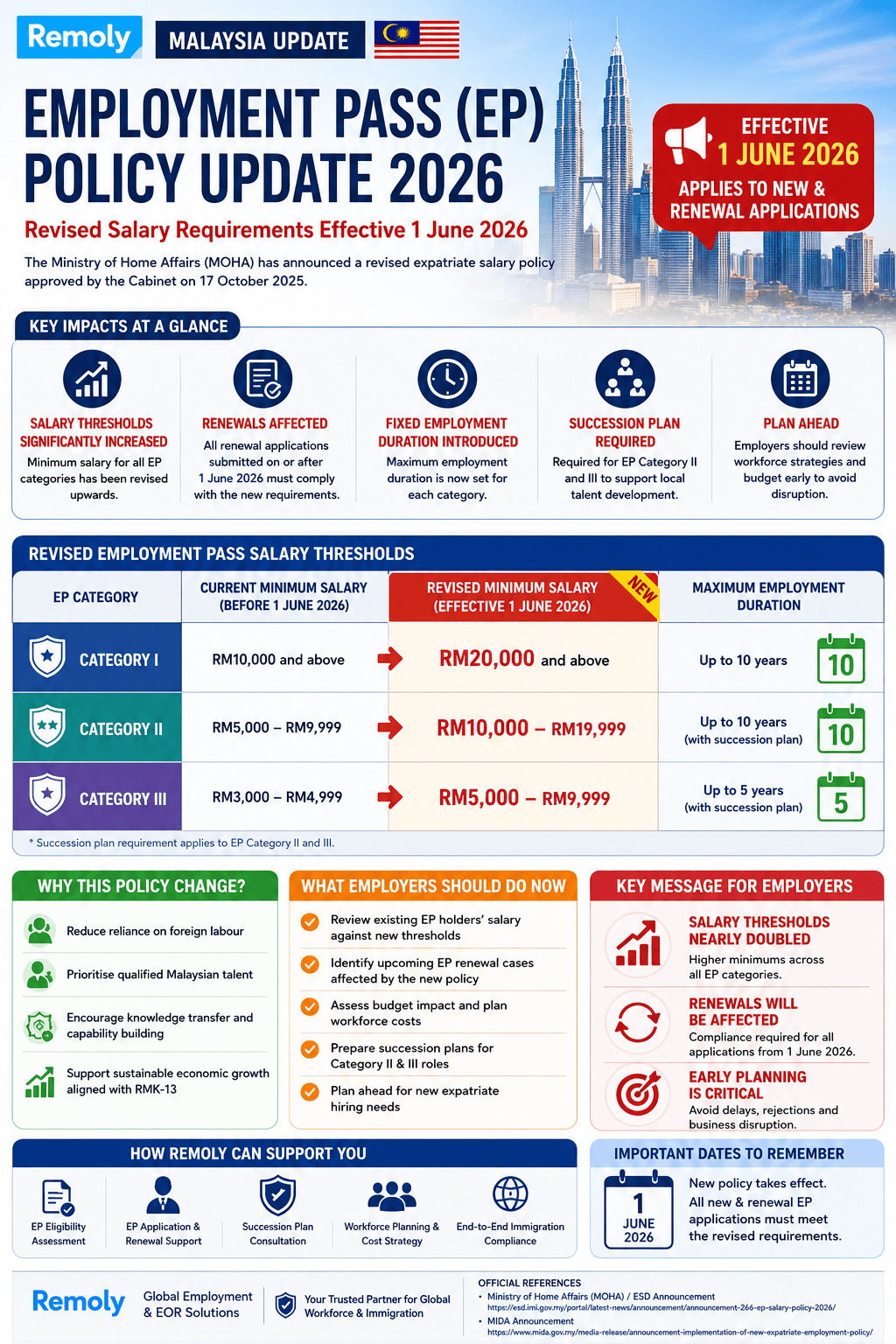
Source: Ministry of Home Affairs (MOHA), Malaysia
Succession Planning and Local Talent Development
The updated framework places greater emphasis on workforce planning and talent development.
According to the announced requirements, certain Employment Pass categories may require employers to provide succession plans that support the development of local talent. As a result, organizations may benefit from reviewing their long-term workforce strategies and identifying opportunities for knowledge transfer and capability building.
For businesses operating in Malaysia, balancing access to foreign expertise with local talent development will remain an important consideration.
Preparing for the June 2026 Implementation
With the implementation date approaching, employers may wish to begin reviewing existing Employment Pass portfolios, projected hiring needs, and budget allocations.
Early preparation can help organizations reduce potential disruptions to renewal processes while ensuring continued compliance with Malaysia's immigration and employment requirements.
As Malaysia continues to refine its foreign talent framework, staying informed of policy developments will be increasingly important for companies employing expatriates or planning future international hires.

Easy to start,
intuitive to use