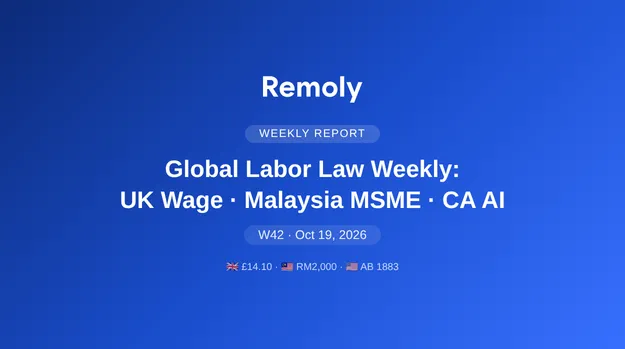
Global Labor Law Weekly: UK Wage, Malaysia, CA AI
From 12 to 18 October 2026, global labor law moved on three fronts at once: the UK raised its voluntary Real Living Wage and launched a consultation on employment status; US states and cities locked in 2027 minimum wage increases while California expanded AI workplace regulation; and Malaysia set out exemptions from its RM2,000 minimum wage. For multinational employers, these are not isolated price adjustments. They are a rewrite of who counts as an employer, how pay is calculated, and whether algorithms can make employment decisions.
1. The Week in Five Numbers
| £14.10 UK Real Living Wage (outside London) |
RM2,000 Malaysia minimum wage (Jun 2027) |
$16.48 New Jersey rate for 2027 |
$518m EEOC recoveries, FY2026 |
Three verbs capture the week: wages are rising, status is tightening, and algorithms are being constrained. The UK is using a voluntary wage floor to lift pay benchmarks while consulting on the boundary between employee, worker and self-employed. The US continues to legislate in fragments, state by state and city by city. Southeast Asia is raising wages and granting exemptions at the same time, which increases rather than reduces compliance complexity.
2. Europe: The UK's Dual Wage and Status Moves
2.1 Real Living Wage rises to £14.10 / £15.45
On 14 October, the Living Wage Foundation announced the 2026 Real Living Wage: £14.10 per hour outside London and £15.45 in London. The rate is calculated independently by the Resolution Foundation to reflect the cost of living. It is not statutory, but more than 15,000 employers have signed up voluntarily.
For a full-time worker at 37.5 hours a week, the new rate equates to roughly £27,000 a year, an increase of more than £1,250. About 500,000 workers benefit directly, including around 76,000 in Scotland and nearly 6,000 in Northern Ireland. Accredited employers are expected to apply the new rate immediately; the statutory National Living Wage continues on the government's annual timetable.
For retail, hospitality, logistics and care employers in the UK, two consequences follow. Accredited employers must adjust pay bands and outsourced rates at once, and large customers may make accreditation a tender requirement. Employers should review contractual pay clauses, recalculate 2027 labor costs, and assess scheduling and automation options for lower-paid roles.
2.2 Employment status consultation targets bogus self-employment
The same day, the UK government published an employment status consultation promising "new action to crack down on bogus self-employment." The consultation revisits the tests that separate employees, limb (b) workers and the self-employed, and examines structures that use individual contractors to avoid minimum wage, holiday pay and pension duties.
Possible outcomes include simplified status tests, stronger enforcement, joint liability for end users, and presumptions aimed at platforms and supply chains. This is still a consultation, not legislation. Any bill would likely arrive in 2027 at the earliest.
Companies using contractors, freelancers or umbrella companies at scale face reclassification risk. A worker finding triggers minimum wage, paid holiday and auto-enrolment pension obligations, potentially with back pay. Employers should map contracts against control, economic dependence and substitution tests, review liability allocation across subcontracting chains, and budget for back taxes and penalties. See analysis from Lewis Silkin and Personnel Today.
2.3 Bulgaria proposes €660; Southern and Central Europe bargain
Bulgaria's government proposed a 2027 minimum wage of €660 a month on 15 October, a 6.4% increase but below the level produced by the previous statutory formula. Unions protested and demanded a return to automatic indexation; employer groups said €660 is acceptable but opposed a higher increase. The proposal is subject to tripartite talks and is due to take effect on 1 January 2027.
Elsewhere, Spain may raise its minimum wage by around 5% before early elections; Greece outlined wage and pension increases for 2027; Hungary entered a crucial minimum wage negotiation; and employers and unions in Moldova jointly called for a minimum wage of 7,600 lei. Elections, budgets and pay floors are now intertwined across Southern and Central Europe, making adjustment timing more political.
2.4 EU unions push for menopause protections at work
On 17 October, the European Trade Union Confederation and women's organizations launched a campaign to have menopause recognized in EU labor law. They argue that menopause symptoms widen the gender pay gap and push women out of the workforce early.
The demands include a menopause risk assessment under the EU occupational safety and health framework, adjustments to hours, temperature, rest breaks and medical appointments, and inclusion of menopause discrimination in equal treatment protections. There is no formal legislative proposal yet, but a Commission strategy or framework directive is possible.
Multinationals should review health and benefits policies for menopause support and train managers not to treat related absence as a performance issue. Guidance in the UK and Ireland offers an early template for group-wide policies.
3. Americas: Wage Increases and AI Regulation
3.1 US states and cities lock in 2027 minimum wages
In mid-October, SHRM and Nixon Peabody published 2027 minimum wage roundups. Most changes are triggered automatically by statute or local ordinance: Ohio rises 3.5% to $11.40; Florida reaches $15.00 under its constitutional amendment; New Jersey rises to $16.48; and multiple California cities adjust above the state floor.
Most take effect on 1 January 2027, with some on 1 July or 30 September. Remote and hybrid work make the employee's actual work location decisive, so multi-state pay bands, job advertisements and overtime exemption thresholds all need recalculation.
Employers should build an employee-location-rate map, update 2027 salary bands and job postings, review exempt salary thresholds, and monitor local rules on tip credits and youth training wages. At federal level, the $20 and $25 proposals remain stalled in Congress and are unlikely to become a uniform standard in the near term.
3.2 California AB 1883 bans AI emotion reading
California enacted a wave of AI workplace laws in 2026. AB 1883 prohibits employers from using AI to infer employees' emotional states from biometric data such as faces, voices or posture, and restricts the collection or use of brain data. Littler described the result on 14 October as lifecycle regulation covering hiring, monitoring, promotion and termination.
AB 1883 applies from 1 January 2027 under its current text. SB 947, the No Robo Bosses Act, bans purely algorithmic terminations and requires human oversight, with compliance changes due by 1 July 2027. Revised stay-or-pay rules also limit recovery of training costs and signing bonuses.
The highest-risk employers use AI interviewing, sentiment analysis, productivity monitoring or wearables. Even offshore vendors can be captured if their tools affect California employees. Employers should inventory emotion-recognition, voice-analysis and brain-data features, obtain vendor compliance statements and data-flow maps, and document human review of AI-assisted employment decisions.
3.3 New York's Trapped at Work Act takes effect on 19 December
Jackson Lewis noted on 14 October that New York's Trapped at Work Act takes effect on 19 December 2026, directly restricting stay-or-pay arrangements and training-cost recovery.
Agreements must meet written disclosure, pro-rata reduction and genuine-cost requirements, and non-compliant terms carry civil penalties and employee claims. Employers using signing-bonus clawbacks, training-linked service periods or relocation repayment in New York should rewrite agreements before the effective date and check for similar legislation in California and other states.
3.4 Canada's Bill C-39 pits approvals against the right to strike
On 12 October, Canada's Liberal government introduced Bill C-39, the Building Canada Strong Act, to accelerate approvals for major infrastructure and energy projects while claiming stronger worker protections. Unions and opposition parties say it weakens the right to strike and environmental review in the name of speed.
The bill would create a fast-track approval mechanism, compress consultation timelines, and set special labor-relations rules for construction periods. Unions rallied in cities across Canada on 15 and 16 October, and a parliamentary committee began clause-by-clause review on 19 October. The bill is not yet law; amendments and third-reading timing are the key variables.
Companies in Canadian infrastructure, energy and mining should weigh faster approvals against labor conflict, community opposition and contractor compliance risk. They should track amendments, budget for labor-relations and community engagement in bids, and review contractor collective agreements and strike contingency plans.
3.5 EEOC recovers $518 million in FY2026
On 16 October, the EEOC reported $518 million recovered for workers in fiscal 2026. Priorities included sex-based pay discrimination, religious accommodation, pregnancy discrimination, and race and age discrimination; class and systemic investigations remain central tools.
This is enforcement data rather than a new rule, but it signals FY2027 priorities. As US headcount grows, EEOC charges and class risk rise, making hiring, performance and pay records the core of any defense.
4. Asia-Pacific: Malaysia's Exemption and Korea's Union Law
4.1 Malaysia sets MSME exemption from RM2,000 minimum wage
Malaysia's 2027 budget raises the minimum wage to RM2,000 a month from June 2027. In mid-October the government set out an exemption for micro, small and medium enterprises with annual sales below RM50 million.
A minister said nearly half the workforce falls within the exemption, prompting criticism that the increase is being diluted. The government launched an e-wages dashboard to monitor compliance, and the human resources ministry is drafting guidance for a RM2,500 graduate minimum wage. Employer groups welcomed the exemption; unions and some lawmakers demanded transparency and an exit timetable.
Eligible employers may defer the increase, but customers, brands and ESG audits may still require RM2,000. Employers should confirm turnover calculations and eligibility, assess recruitment competitiveness even if exempt, and update 2027 payroll and EPF/SOCSO contributions.
4.2 Philippines: Central Visayas increases take effect
Regional wage boards in the Philippines continued to roll out new rates in mid-October. The Central Visayas increase took effect on 14 October, while the National Capital Region's P85 proposal remains contested. Labor groups say the increase is insufficient and demand faster, larger adjustments; a P42 regional increase was dismissed as token.
The Philippines is a major BPO, customer service and shared-services hub. Regional differences create "same role, different pay" issues, and cross-region deployment or remote work must follow the employee's actual work location. Night differentials and overtime follow the new base.
4.3 Bangladesh convenes garment wage board
On 17 and 18 October, Bangladesh began forming a new wage board for the ready-made garment sector ahead of its 2026 wage review. Unions are demanding Tk30,000 a month and better overtime and benefits; employers warn that a large increase would squeeze margins and export competitiveness and favor phased adjustment.
A new wage order is expected in 2027. Apparel, home textile and footwear buyers face higher FOB quotes and supplier compliance reviews, and brands may lock prices early or shift orders. Buyers should track the board timetable, renegotiate 2027 pricing and cost sharing, audit overtime and payment practices, and assess alternative capacity in Vietnam and Indonesia.
4.4 Korea's Yellow Envelope Act: employer backlash after seven months
Seven months after Korea's Trade Union Act amendment, known as the Yellow Envelope Act, employer groups said on 14 October that four in ten companies consider labor commission rulings inappropriate. They argue the law turns safety-compliance disputes into excessive liability.
The amendment limits large damages claims against lawful union action and broadens protection for industrial action, reducing legal risk for strikes and collective action. Employers report longer negotiations and higher disruption costs, especially in shipbuilding and autos. The government is also preparing an equal-pay-for-work-of-equal-value roadmap within a year.
Companies operating in Korea or sourcing from Korean suppliers should refresh labor-risk maps and contingency plans, review union relations and stoppage history, and assess how the equal-pay roadmap may affect pay structures.
5. Middle East and Africa: From Legislation to Enforcement
5.1 Qatar bans recruitment fees charged to workers
On 16 October, Qatar published rules prohibiting employers and recruitment agencies from charging job seekers or workers recruitment fees. Costs must be borne by the employer and cannot be passed on as agency, visa or medical fees. Violators may lose licenses, face fines and bear worker losses.
The rules sit alongside the minimum wage, the Wage Protection System and free job mobility. Employers recruiting from South and Southeast Asia should audit agency contracts and fee structures, set up reimbursement for worker-paid costs, and keep evidence for ESG and customer audits.
5.2 Oman, Bahrain and Kuwait tighten hours, rest and pay rules
Oman confirmed an eight-hour daily limit under its 2023 Labour Law and published minimum annual and emergency leave rules. Bahrain designated Friday as the weekly rest day and set conditions for changing it. Kuwait published minimum wage and wage-payment rules, strengthening transfer and record-keeping requirements.
Gulf states are moving from headline reforms to enforcement detail, with working time, weekly rest and payment practices under inspection. Employers should update time and scheduling systems by country, verify payment channels and records, review expatriate contracts and leave entitlements, and prepare inspection files.
5.3 South Africa and Nigeria: rest rules and wage reviews
South Africa's labor department clarified rest-time rules in mid-October, covering daily rest, weekly rest and overtime compensation, while employer groups rejected a draft employment-equity plan. Nigeria's labor congress rejected the federal government's three-year minimum wage review cycle; the government says the next review is due in June 2027.
Employers in South Africa should audit scheduling, rest and overtime records. In Nigeria, they should budget for a June 2027 review and monitor the final employment-equity code.
6. Five Signals and a 90-Day Checklist
Five signals stand out: minimum wages are politicized, employment status is being tested on substance, AI is regulated across the employment lifecycle, supply-chain labor standards are becoming audit items, and Gulf enforcement is catching up with reform. The ILO made the same point on 17 October, urging trade policy to reinforce international labor standards rather than compete by lowering protection.
Next 90 days:
1. Recalculate 2027 minimum wage costs at country, region and city level across the UK, US, Malaysia, Bulgaria and the Philippines.
2. Map UK contractor and self-employed arrangements against control, dependence and substitution tests.
3. Inventory emotion-recognition, voice-analysis and brain-data features in HR technology and prepare AB 1883 compliance files.
4. Rewrite New York stay-or-pay agreements before 19 December.
5. Review supply-chain compliance for Malaysia's MSME exemption, Bangladesh's wage board and Qatar's zero-fee rule.
Ready for 2027 wage increases and AI workplace rules?
UK status reclassification, US state wage increases, California's AI bans and Southeast Asian supply-chain audits are converging. Remoly's global employment experts provide country-specific compliance assessments, payroll cost modeling and local implementation support.
contact@remoly.net · Talk to our team →
* This article is for general information only and does not constitute legal advice. Policies and data are subject to official publications in each jurisdiction.
Related Articles



Related Articles