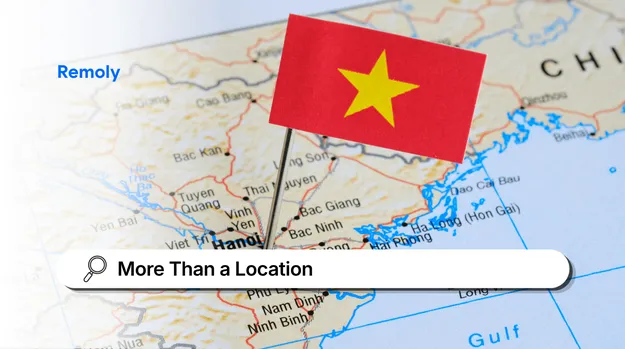
Choosing a Factory Location in Vietnam: What Else Matters?
Choosing a Factory Location in Vietnam: What Else Matters?
When companies start looking for a factory location in Vietnam, the first questions are often straightforward.
How much does the site cost?
Where is it located?
How large is the available space?
Those questions matter. But they are only part of the decision.
For a manufacturing project, the location of a factory can affect much more than the initial cost of setting up the site.
It can influence logistics, access to workers, utilities, supplier relationships, and even how easily the project can move from construction to actual operations.
That is why a site that looks attractive on paper may not always be the easiest one to operate from.
A Lower Cost Does Not Always Mean a Lower Cost of Operation
The initial site cost is easy to compare.
Operating costs are not always as obvious.
A location further away from suppliers or customers may offer lower land or rental costs, but increase transportation time and logistics expenses.
Similarly, a site that looks affordable may require additional preparation or coordination before it can support the project's operational needs.
The point is not that a more expensive location is automatically better.
It is that the initial price should be considered alongside the costs that may continue throughout the life of the factory.
Think About the People, Not Just the Site
A factory needs people to operate.
For manufacturers, the availability of workers in the surrounding area can therefore be just as important as the physical characteristics of the site.
Businesses may need to consider:
- the local labour pool;
- access to skilled workers;
- commuting patterns;
- competition for workers from nearby businesses; and
- the practicality of recruiting and retaining employees.
A location can be well connected for cargo but less convenient for the workforce.
That difference may not be obvious when looking at a map.
Logistics Is More Than Distance
Being close to a port, major road, or customer is useful.
But distance alone does not tell the whole story.
Manufacturers may need to move raw materials into the factory, transfer goods between suppliers and production sites, and eventually deliver finished products to customers or export points.
The condition of local roads, traffic patterns, transportation options, and the reliability of the logistics network can all influence day-to-day operations.
In other words, a location that looks "close" on a map may not always be the most efficient in practice.
Utilities Deserve Attention Early
Production depends on more than the building itself.
Depending on the manufacturing process, a project may have specific requirements for electricity, water, wastewater treatment, telecommunications, or other utilities.
These requirements should be considered during site evaluation rather than after the location has already been selected.
The question is not simply whether a utility is available.
It is whether the available infrastructure is suitable for the project's actual requirements and future plans.
Leave Room for the Project to Grow
A factory is rarely planned only for today.
Some businesses may eventually add production lines, increase capacity, expand storage, or change their operational layout.
That does not mean every project needs a large site.
It does mean that future requirements are worth considering before making a long-term location decision.
A site that works perfectly for the initial phase may become restrictive if the business grows faster than expected.
There Is No Single "Best" Location
Vietnam has a wide range of locations suitable for different manufacturing activities.
But there is no universal answer to which location is best.
A site that works well for an export-oriented manufacturer may not be the best choice for a business serving a domestic customer base.
Likewise, a labour-intensive operation may have very different priorities from a highly automated facility.
The right question is therefore not:
"Which location is the best?"
It is:
"Which location makes the most sense for this particular project?"
Location Is a Project Decision
Choosing a factory site is often treated as a real estate decision.
For manufacturing projects, it is better understood as part of the wider project planning process.
The site affects what happens after the factory is built: how people get to work, how materials move, how utilities support production, and how easily the business can adapt as operations change.
That is why the best site is not necessarily the cheapest, the largest, or the closest to a major city.
It is the one that fits the project's actual operational needs.
Key Takeaway
A factory location is more than a point on a map.
Before choosing a site, businesses need to look beyond the initial price and consider the practical realities of operating there.
Because the cost of a location is not only what you pay to secure it.
It is also what the location asks your business to deal with every day.
Source: Invest Vietnam – General project-planning considerations for manufacturing investment in Vietnam. Specific site requirements vary by project, industry, location, and applicable regulations.
???? Choosing a factory location in Vietnam?
Beyond land and rent, workforce access, logistics, and utilities shape how smoothly your manufacturing project operates. Remoly's global employment experts can support your entity setup, workforce planning, and operational readiness in Vietnam.
???? contact@remoly.net · Talk to our team →
* This article is provided for general information only and does not constitute legal or investment advice.