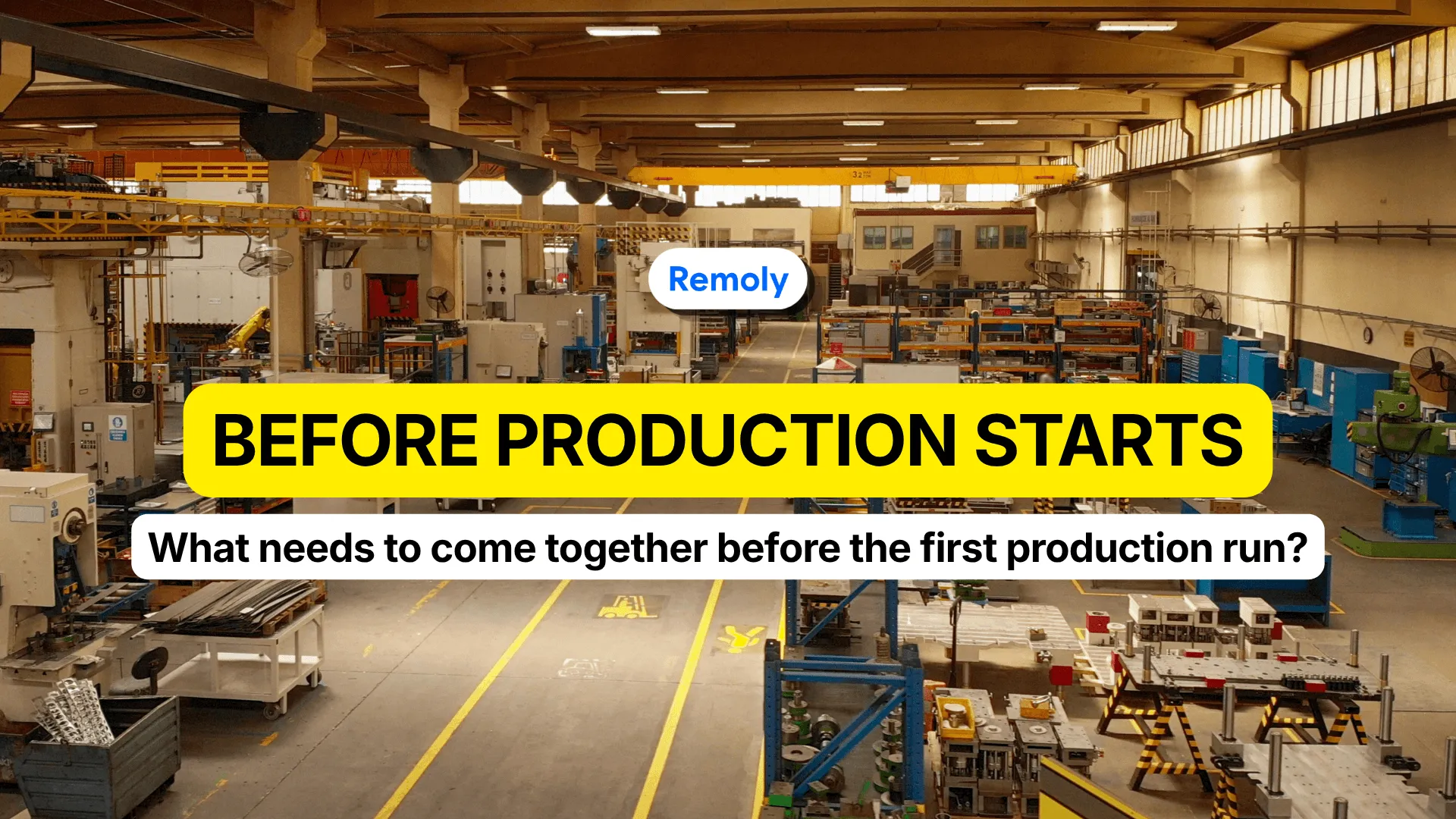
Before the First Production Run
Before the First Production Run
A new factory can look almost ready before it has actually produced anything.
The building is finished. Equipment has been installed. Production areas are taking shape. The team is starting to come together.
But there is still a gap between having a completed facility and running a production process for the first time.
The first production run is where different parts of the operation have to work together for the first time. Equipment, materials, people, processes, and quality controls all meet on the production floor.
That is why the first run is often less about simply “starting the machines” and more about finding out whether the whole system works together as expected.
What Needs to Come Together?
There is no universal checklist for every factory. The preparation will depend on the industry, production process, equipment, and scale of the operation.
But several areas commonly need to be considered before a new production line can run.
- Equipment — Are the machines installed and ready for the intended production process?
- Materials — Are the required raw materials, components, and other inputs available?
- People — Are the operators and production team ready to work with the equipment and process?
- Process — Has the production workflow been prepared and understood by the team?
- Quality — Are the relevant quality checks and procedures ready to be applied?
- Trial Run — Is there an opportunity to identify and adjust issues before production moves into a more regular rhythm?
These points are connected.
A machine can be ready, but production may still be affected if the required materials are not available. The materials may be ready, but the team may still need time to become familiar with the process.
This is why the first production run is useful as a reality check for the entire setup.
The First Run May Reveal Things That Planning Cannot
Planning can identify many potential issues before production begins.
But some problems only become obvious when the actual process is running.
A material may not move through the process as expected. An operator may find that a particular step takes longer than planned. Equipment settings may need adjustment. A quality issue may appear that was not obvious during preparation.
None of this necessarily means the project was poorly planned.
A new production system is being put into practice for the first time, and some adjustment is part of that transition.
Production Is a System, Not a Collection of Separate Parts
This is where the first production run becomes more important than it may initially appear.
A factory does not operate through equipment alone.
It depends on equipment, people, materials, processes, and supporting systems working together.
If one part is not ready, another part may be affected.
For example, having a production line installed does not help much if the team is not ready to operate it. Having the right workforce does not solve the problem if the required materials are not available.
The goal is therefore not simply to have every individual component ready.
The goal is to have the components work together.
From First Run to Normal Production
The first production run is also not necessarily the same as normal production.
A new factory may need time to adjust processes, improve coordination, address quality issues, and understand the actual production rhythm.
As these adjustments are made, the operation can gradually move toward a more stable production process.
That is why “first production” should not always be viewed as the finish line.
It is better understood as another stage in getting the operation up and running.
What Does “Ready” Actually Mean?
A factory can be physically complete without being operationally mature.
The same applies to a production line.
Having the equipment installed is one milestone. Having the team, materials, processes, and quality controls working together is another.
For businesses preparing a new manufacturing operation, this distinction can be useful when thinking about timelines.
Instead of asking only:
“When will the factory be finished?”
it can also be worth asking:
“When will the production system be ready to run?”
A Simple Takeaway
The first production run is more than the moment when a factory starts making products.
It is the point where the different parts of the operation finally come together and are tested in a real production environment.
A factory can be built in months. Building a stable production rhythm can take longer.
Note: The preparation required before initial production varies depending on the industry, production process, equipment, facility, and operating model. This article provides general manufacturing project-planning observations and does not constitute legal, engineering, or professional advice.
Source: General manufacturing project-planning considerations.
Getting a new production line ready to run?
From equipment installation to trial runs and operational readiness, the first production run tests the entire system. Remoly's global employment experts can support your entity setup, workforce planning, and manufacturing project preparation in Vietnam.
contact@remoly.net · Talk to our team →
* This article provides general project-planning observations and does not constitute legal, engineering, or professional advice.
Related Articles


Easy to start,
intuitive to use
