Many businesses spend a lot of time deciding where to expand. A question that is often overlooked is when.
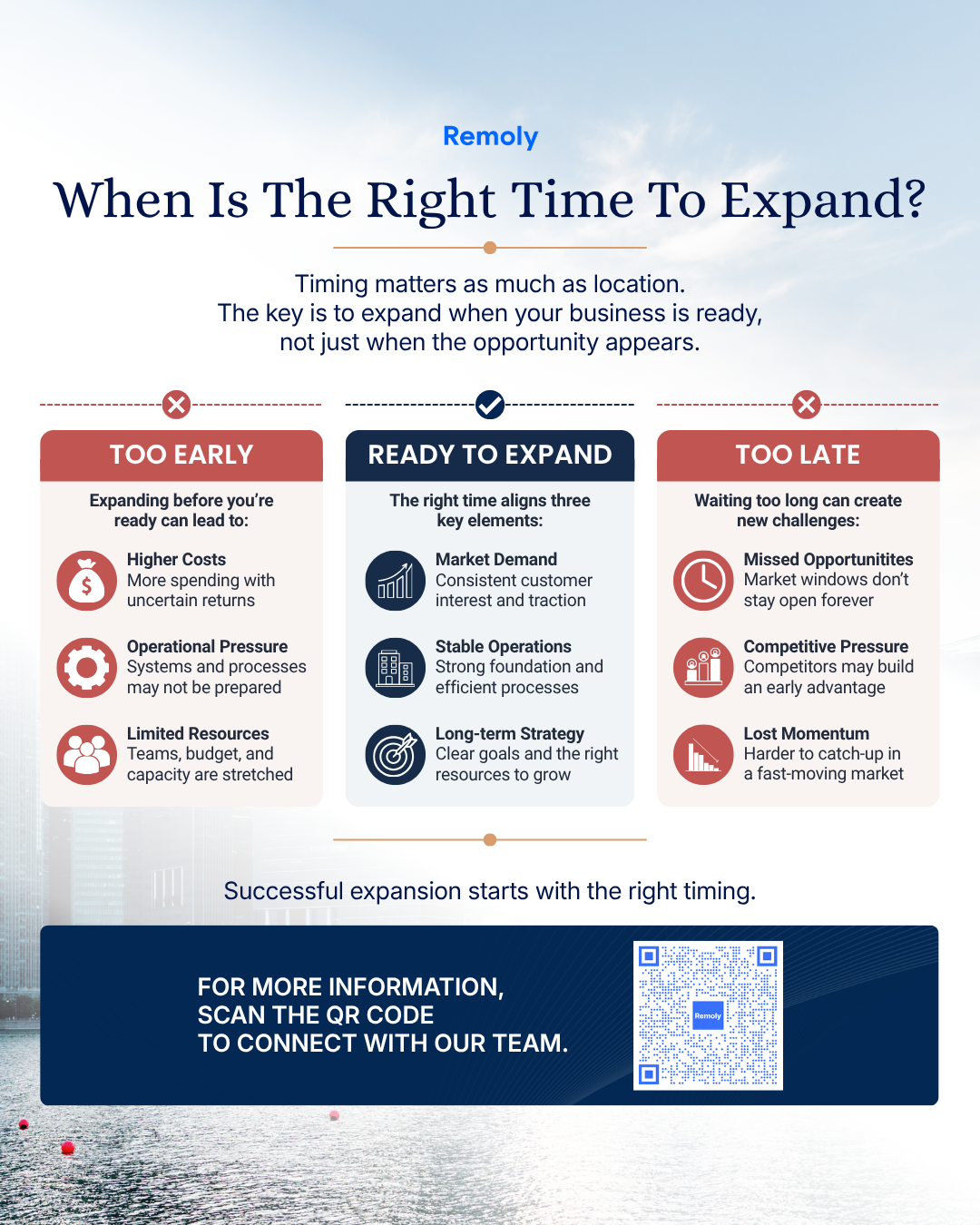
Expanding too early can create unnecessary costs and operational pressure. Expanding too late can mean missing market opportunities and losing momentum to competitors. The challenge is finding the point where expansion supports growth rather than becoming a distraction from it.
Start with Demand, Not Geography
Many companies begin by comparing countries, tax rates, or incorporation costs. In reality, expansion decisions are often stronger when they begin with customer demand.
If a business is already receiving consistent inquiries, orders, partnerships, or hiring needs from a region, expansion may be responding to an existing opportunity rather than trying to create one from scratch.
Signs Your Business May Be Ready to Expand
There is no universal checklist, but several signals often indicate that a company is approaching the right stage for international expansion.
- Revenue has become relatively stable.
- Operations can run without constant founder involvement.
- Customer demand exists beyond the home market.
- The company has resources to support hiring, compliance, and market entry.
- Expansion is part of a long-term strategy rather than a short-term experiment.
Why Expanding Too Early Can Be Expensive
Entering a new market involves more than registering a company.
Businesses may need to manage recruitment, payroll, compliance, banking, legal requirements, and ongoing operations. If the core business is not yet stable, these additional responsibilities can consume significant time and capital.
For many companies, the cost of premature expansion is not only financial — it is also operational focus.
Why Waiting Too Long Can Also Be Risky
At the same time, waiting indefinitely has its own risks.
Competitors may establish relationships first, local talent may become harder to attract, and market opportunities may become more crowded over time. In fast-growing regions such as Southeast Asia, timing can matter as much as location.
The Better Question
Instead of asking "Which country should we enter?", businesses may benefit from asking:
"Is our business ready to succeed in a new market?"
The right time to expand is rarely defined by a calendar date. It is usually the moment when market opportunity, operational readiness, and long-term strategy begin to align.
The Best Expansion Decisions Start Before the Expansion
Successful international growth is often less about moving quickly and more about moving at the right time.
Companies that expand sustainably tend to combine market opportunity with operational readiness, ensuring that growth in a new market strengthens the business rather than stretching it too thin.
Before choosing a destination, it may be worth asking a simpler question first: Are we ready for the next stage of growth?

Easy to start,
intuitive to use