When businesses plan to expand into Southeast Asia, Singapore and Malaysia are often among the first markets considered. Both offer attractive business environments, but they are built around different strengths.
The more useful question isn't which market is better. It's which market is better suited to your business strategy.
Start with Your Business Objectives
Before comparing locations, businesses should first define what they want to achieve.
Are you setting up a regional headquarters? Expanding sales across Southeast Asia? Building a manufacturing base? Or creating a more cost-efficient operating model?
Each objective calls for a different approach, and that often influences which market makes more strategic sense.
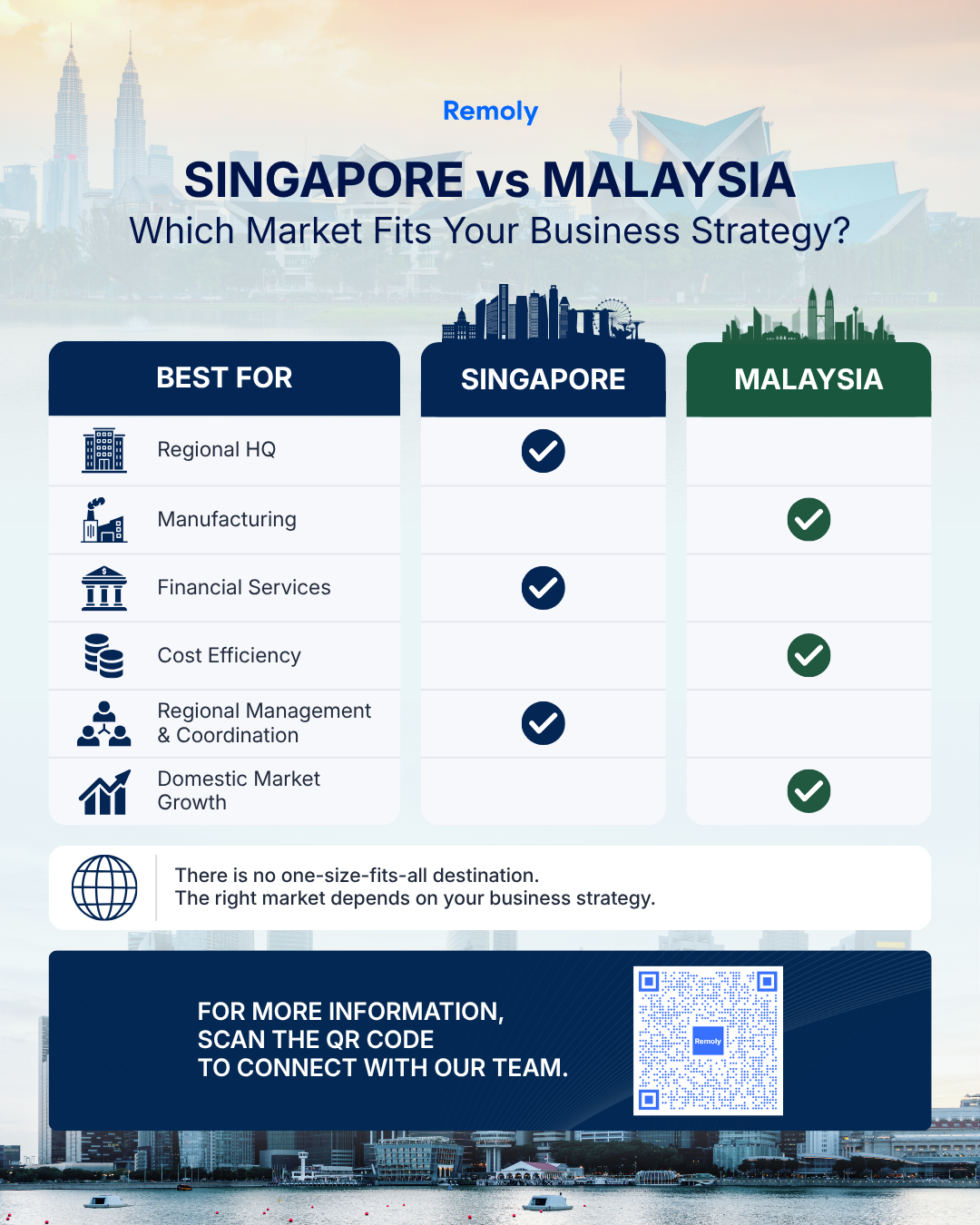
Why Many Businesses Choose Singapore
Singapore is often selected by companies that value regulatory transparency, international connectivity, and a highly developed business ecosystem.
For businesses managing regional operations, serving international clients, or coordinating teams across multiple countries, Singapore continues to offer advantages that extend beyond market size alone.
That said, these strengths are typically accompanied by higher operating costs. Businesses should therefore evaluate Singapore not only as a place to enter the market, but as part of a broader long-term growth strategy.
Where Malaysia Stands Out
Malaysia offers a different set of opportunities.
Businesses focused on manufacturing, shared services, or cost-conscious expansion may find Malaysia better aligned with their operational priorities.
Its competitive operating costs, established industrial sectors, and sizeable domestic market continue to make it an attractive option for companies seeking both growth and operational efficiency.
For many organisations, Malaysia isn't necessarily an alternative to Singapore—it can also be a complementary part of a regional expansion strategy.
Why Cost Shouldn't Be the Only Factor
Operating costs are an important consideration, but they rarely tell the whole story.
Choosing the right market also means understanding where your customers are, how you plan to build your workforce, what regulatory requirements you'll face, and how each location supports your long-term business goals.
A market that appears more expensive today may deliver greater strategic value over time, while a lower-cost option may be the right choice for businesses with different priorities.
Choosing the Right Market Starts with the Right Strategy
Singapore and Malaysia each bring different strengths to the table.
Rather than searching for a universally "better" destination, businesses are better served by identifying the market that best aligns with their operational needs, expansion goals, and long-term direction.
Successful expansion is rarely about choosing the most popular destination. It's about choosing the one that best supports where your business is heading.

Easy to start,
intuitive to use