Singapore has introduced several employment policy changes in 2026 that will influence workforce planning, employment compliance, and hiring strategies. While these reforms continue to strengthen employee protection and workforce sustainability, they also require employers to reassess operational planning beyond salary considerations.
This article outlines three key regulatory changes and their potential implications for businesses hiring or expanding in Singapore.
Singapore remains one of Asia's leading business destinations for multinational companies, regional headquarters, and international investors. Its stable regulatory environment, skilled workforce, and transparent legal framework continue to make it an attractive market for business expansion.
As Singapore's labour market evolves, employers are also expected to adapt to new employment requirements. The latest policy changes introduced in 2026 reflect the government's continued focus on supporting families, extending workforce participation, and maintaining a sustainable labour market.
For businesses planning to hire in Singapore, understanding these developments is essential for effective workforce planning and long-term compliance.
Key Regulatory Changes
1. Shared Parental Leave Expanded to 10 Weeks
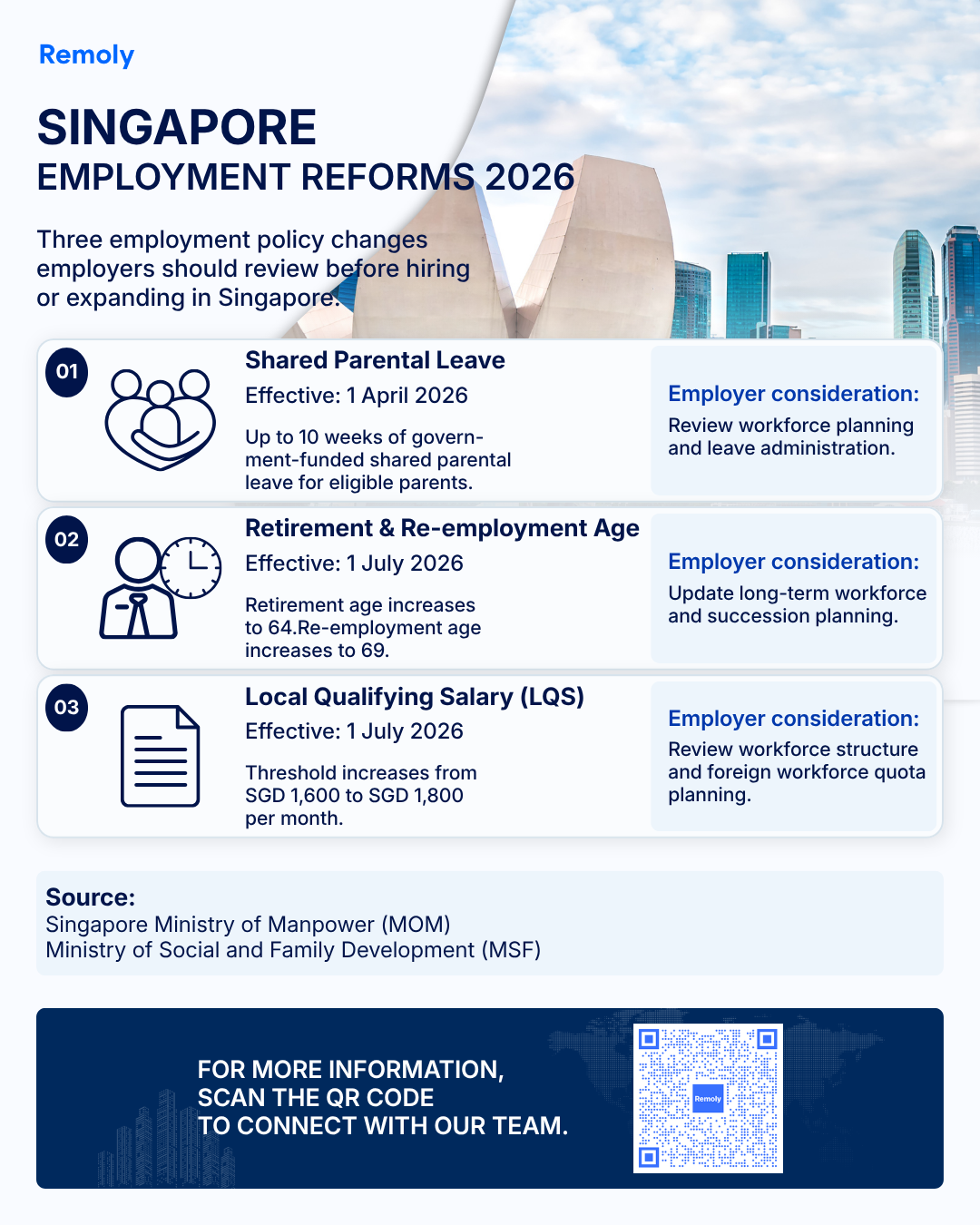
Effective from 1 April 2026, eligible working parents may share up to 10 weeks of government-paid Shared Parental Leave. Together with existing maternity and paternity leave provisions, eligible families may receive up to 30 weeks of paid parental leave during a child's first year.
For employers, the change highlights the importance of reviewing workforce planning, leave administration, and internal processes to support business continuity while meeting statutory employment obligations.
2. Retirement and Re-employment Ages Increased
From 1 July 2026, Singapore's statutory retirement age increases to 64, while the statutory re-employment age increases to 69.
Although the adjustment is part of Singapore's long-term workforce strategy, employers may wish to review succession planning, workforce allocation, and employment policies to accommodate longer employment cycles.
3. Local Qualifying Salary (LQS) Threshold Revised
Also effective from 1 July 2026, the Local Qualifying Salary (LQS) increases from SGD 1,600 to SGD 1,800 per month.
The revised threshold may affect how local employees are counted for foreign workforce quota calculations, depending on an employer's workforce profile. Businesses that employ foreign workers should review their workforce structure and salary arrangements to understand the potential impact.
Employer Considerations
Employment costs in Singapore extend beyond monthly salaries. Businesses should also consider statutory employment obligations, workforce planning, foreign workforce eligibility, and ongoing regulatory compliance when developing hiring strategies.
Early planning can help employers better manage compliance requirements while supporting sustainable business growth.
Key Takeaways
- Singapore's 2026 employment reforms introduce important changes affecting workforce planning and compliance.
- Employers should review employment policies, workforce structures, and hiring strategies in light of the updated regulations.
- Understanding regulatory developments early can help businesses make more informed expansion decisions and reduce future compliance risks.
Official References
The information presented in this article is based on official guidance published by:
- Singapore Ministry of Manpower (MOM)
- Singapore Ministry of Social and Family Development (MSF)
Disclaimer
This article is provided for general informational purposes only and does not constitute legal, tax, or professional advice. Employment regulations may change over time, and their application depends on individual business circumstances. Businesses should refer to the latest guidance issued by the relevant Singapore government authorities or seek professional advice before making employment or expansion decisions.

Easy to start,
intuitive to use